
Next tour
Myths & Legends
Ghosts, curses and the darker legends of the Old Town, told in the lanes where they are said to have happened.
Tour V, Hidden Tallinn
A short, slow walk through the doors most visitors pass, into the courtyards behind them.
The introduction is free.

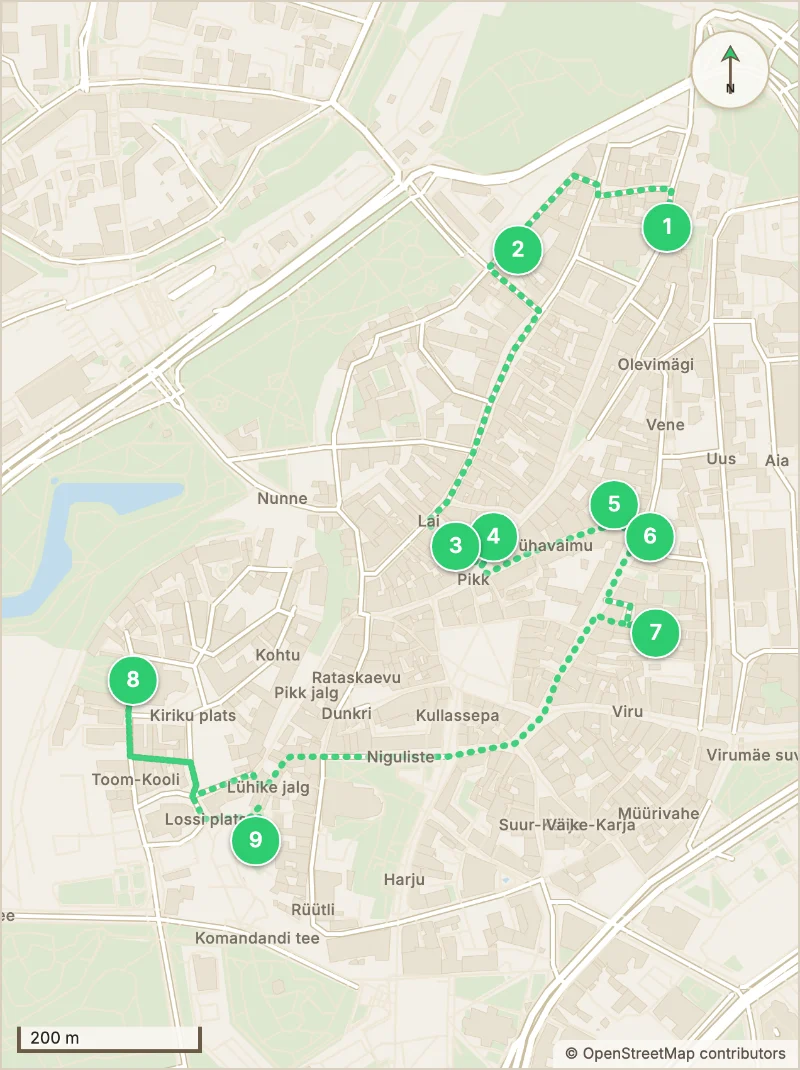
The Old Town's best spaces are the ones you would walk straight past. This is a short, gentle walk through hidden courtyards: nine doorways most visitors never open, leading to gardens, ateliers, and cafés tucked inside the medieval blocks.
It is our most relaxed tour: just over two kilometres, with one short climb up to Toompea, made for lingering. Bring time for a coffee at the end.


01 / 04
Three medieval merchant houses fused into one. Slip into the lane beside them and the hidden Old Town begins.
A hand-carved wooden Ukrainian church and monastery yard against the wall on Laboratooriumi, with the three-handed icon, and a prayer slot in the door.
The narrow Exchange Passage between Pikk and Lai streets, once the merchants' shortcut. Easy to walk straight past, quiet as a held breath.
A small courtyard tucked behind the Holy Spirit Church, under Tallinn's oldest public clock, that few visitors ever find.
The green inner courtyard of the 1246 monastery: worn cloister walks, carved stone, and a stillness the street never reaches.
Katariina käik by its quiet door: the tombstones of the old church set into the wall, and artisans still at work in the arches.
Through an archway on Vene Street into a layered medieval yard of galleries and studios: a courtyard within a courtyard.
The quiet garden beside the Dome Church on Toompea: benches under old trees, the city's noise left at the foot of the hill.
Where the Danish flag is said to have fallen from the sky in 1219. Three bronze monks keep watch over the slope, and the walk ends in the open.
All five walks, the walking map and the guide, unlocked in this browser. Every walk's introduction is free to hear first.
Next tour
Ghosts, curses and the darker legends of the Old Town, told in the lanes where they are said to have happened.