
Next tour
Hidden Courtyards
A short, slow walk through the doors most visitors pass, into the courtyards behind them.
Tour IV, Power & Architecture
The hill that ruled the harbour. Cathedrals, the castle, and the two best views of the city.
The introduction is free.

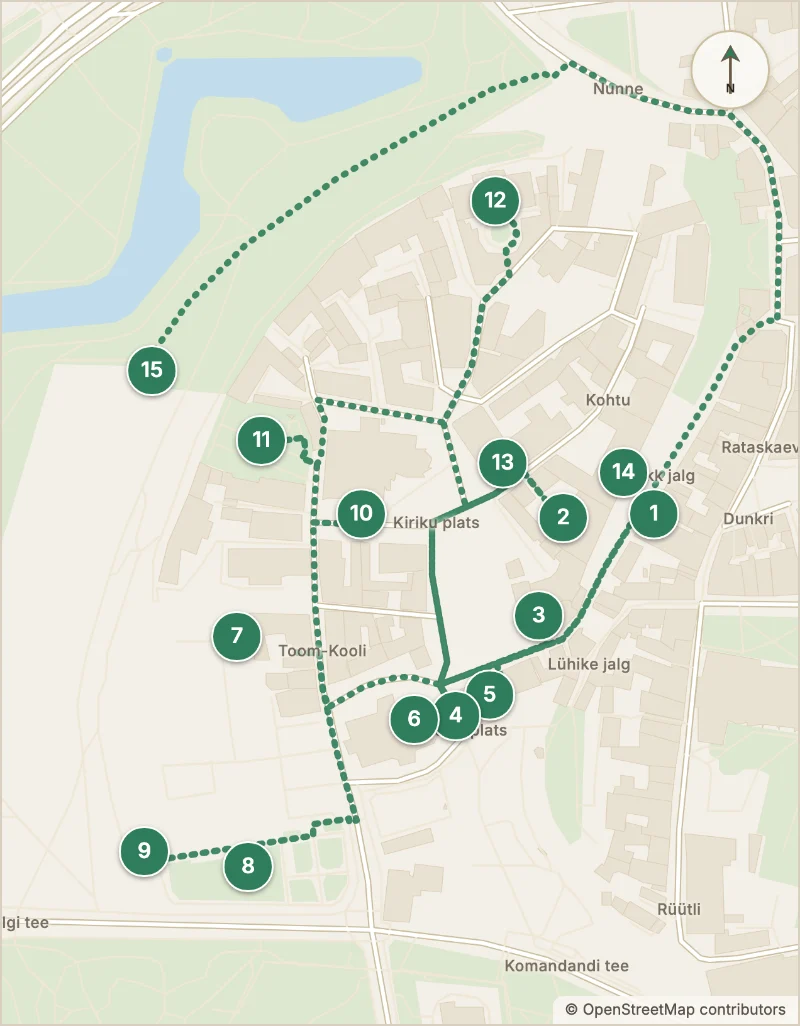
Toompea is the upper town: where the bishops, knights, and governors lived, walled off above the merchants below. This is the tour of power and stone and the steepest walk we offer, climbing from the lower gate to the castle and the great viewing platforms.
Wear proper shoes. The reward is the best panorama of the Old Town's red roofs and the Baltic beyond, best caught in the last hour of light.


01 / 05
The Long Leg: the gentle medieval road up to Toompea, sealed by its gate-tower every night for centuries. The climb to power begins.
A Baltic-German noble palace built 1865–68 by Berlin architect Martin Gropius; the nobility gone, it now houses the Estonian Academy of Sciences.
The Short Leg's gate tower, raised by Hans Kotke in 1454–56: the lockable seam between the merchant town and the noble hill.
Castle Square, the stage on which Tallinn's rulers performed their power, between the pink castle and the Russian cathedral.
Official residence of the Estonian head of state 1919–29; Konstantin Päts moved in on 20 December 1921. Today the German Embassy.
An imperial power-statement in stone, built 1894–1900. A symbol of Russification that Estonia scheduled for demolition on 1 May 1929, and then spared.
Seat of every ruler since the Danes (bishops, knights and tsars) and now the Estonian Parliament behind its pink baroque facade.
One of Tallinn's first public parks, laid out in the 1820s beneath the castle wall: the place where power came to sit down.
The great limestone tower where, each dawn, the blue-black-white of Estonia rises to the anthem. Whatever flies from Tall Hermann rules the land.

The oldest church in mainland Estonia, its walls and floor paved with the carved arms and tombs of the Baltic nobility.
A hidden cathedral garden on the western edge, with a restored medieval well and Toompea's two oldest oak trees.
Begun in 1787 as a courthouse but never used as one; since around 2000 the seat of the Government of Estonia.
The grand seat of the Estonian Knighthood, the Baltic-German nobles who governed the province. Today part of the national art collection.
The postcard view: spires, red roofs and the harbour spread below, the whole Lower Town at your feet.
The other great overlook: the sea, the station, and the longest surviving stretch of medieval wall descending the hill.
All five walks, the walking map and the guide, unlocked in this browser. Every walk's introduction is free to hear first.
Next tour
A short, slow walk through the doors most visitors pass, into the courtyards behind them.